
These notes are specific to newsXpress members using the new Tower Systems developed Discount Voucher facility. I have prepared them in response to questions from some of you and to share my experiences since using these since February 2013 in my own shops. Mark Fletcher.
How I use them works for me. I can’t promise they will work for you since each situation is different. My use has been in capital city shopping centre situations.
Background
At several retail conferences over the last eighteen months I have been hearing about consumer fatigue with points based loyalty programs. It resonated with me as I don’t trust the programs. You only have to look at the lack of a reasonable reward from Coles and Woolworths to understand how fatigue can set in. So, I felt that a different, non VIP card / program was required to cut through – it had to be different to and disconnected from a loyalty program as we knew it.
In my own retail situation I see plenty of infrequent shoppers and I want to tap into that opportunity and get them spending more in the visit.
I’d been running the Magazine Club Card for years and worried about moving form that. So, when the software was ready, we went cold turnkey and turned off the magazine Club Card and turned on Discount Vouchers.
Customer reaction
While we have had some complaints, they have been from no more than ten customers per store. Most were happy once they saw the vouchers working. Only one or two in each store were what I’d call angry. They are the people who cost the most with the magazine club card – lowest spend for highest reward.
I felt and still feel it is important to have only one loyalty program running at any time. Hence the decision to turn the Magazine Club Card off.
In one store we had the newsXpress Rewards, points based program, running with just under 1,000 customer signed up. We went cold turkey with that, turned it off. However, we did make a two-week offer to say thanks. Only one customer complained.
Why switch?
Discount vouchers comes with incredible reporting showing you exactly how they are being used, your contingent liability at any time and other key data from which you can make informed decisions.
For me, the key reason to switch was to differentiate my business from others with loyalty programs. The vouchers are transparent and the opportunity to save is immediate and real.
Fourteen weeks in – I’m very happy with how they are performing.
How they work
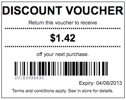
The discount vouchers are printed on the bottom of receipts. Your business rules, which you can change at any time, determine the sales for which they are eligible, discount value, their shelf life - how long they are live for and the products for which they can be redeemed.
You also control the detail on the vouchers including what they are called – yes you could call them something other than DISCOUNT VOUCHER, all the text and terms and conditions.
Retail staff love them as there is no extra work to get the vouchers printing. While they need to pitch them to customers, this is easy … but important too!
Staff also love them in that they can hide behind the technology when a customer wants to use an expired voucher … computer says no.
Customers love them as they’re clear - $1.42 off (in the example above). What’s not to understand about that? Nice.
How to harvest customer details
When a customer uses a voucher, ask them to give you their name and number or name and email on the back to go in the running for a monthly prize – say a $25 shopping voucher. This is just one of several ways you can get their details. Plus, you can include space on the voucher for them to fill in their details. Easy!
A charity connection
At Christmas we plan on supporting a local charity. For the month of December. Shoppers who don’t want to use their voucher or just wish to donate it will have the opportunity to do so. We will add up the value after Christmas and donate a percentage of that amount to the charity – somewhere between 10% and 20% as it’s not our only charity contribution.
Settings
Here are the settings I suggest. Think about what you want for your business. Don’t just go with what I suggest as I could be wrong for your business.
- Term. 28 days is what I have at the moment. Make the vouchers too long and you are discounting for purchases people would have made anyway.
- Dept/Cat contributions. Okay this requires careful thought. It’s the percentage of the purchase value from an item in each department that goes into what I call the ‘bucket’ from which the voucher value is calculated.
A guide is to go with the GP – magazines 25%, gifts 50% etc. This way you know you are only giving away from GP. I have not done that however.
What I did was to go with 100% most departments: magazines, gifts, stationery, plush, cards – as I am using the second setup to determine setting the voucher value. It set ink at 35%, confectionery at 30% and copying at 50%. I did this expecting around 10% of vouchers to be redeemed.
You also this section to set to 0.00% departments and categories for which you will not accumulate $$$ for vouchers – bus tickets, lotteries, mobile phone recharge.
The third setting opportunity here is for redemption. You can tick whether voucher value can be used for redemption for this department and category.
- Voucher setup. This is where you set the percentage of what is in the ‘bucket’ that makes up the voucher value.
The contribution total is the trigger point for the associated percentage. In my case, where 100% of product purchase value is going into the bucket for many items, we have set the following contribution totals: $5.00 – 10%; $10.00 – 10.5%; $15.00 – 11%; $20.00 – 11.5%; $30.00 – 15%. So, someone spending $30.00 on magazines will get a voucher worth $4.50.
On this Voucher setup screen you also get to set how the discount vouchers facility behaves on different days of the week and for different types of customers. I suggest you don’t tweak this too much until you settle vouchers into your business.
Writing about this now, it’s time for us to reconsider our own voucher settings. We’ve handed out more than 10,000 vouchers and have a good data set to analyse and guide adjustments. For example, I think it was wrong to penalise ink and be so generous with magazine customers. I am planning a contribution for ink at 100% and magazines 75%.
My settings are higher than some would suggest for magazines. I’ve done this since they pull good traffic and I want to leverage that into sales of other items in-store. It’s a fine line to walk there.
Considering redemption
I have looked at data for three newsagencies and three other businesses where Discount Vouchers have been on trial since February. Average redemption is 10% of vouchers issued. Consider this when setting your percentage for the bucket and percentage on the voucher.
There is a strong case for increasing voucher value from higher value purchase items – rewarding those who spend on high GP items. Yes, the vouchers will often be used for guilty pleasure purchases- in our case women’s weeklies titles – however, this is what it is. By that I mean that newsagencies have some items people will only buy on sale or when they have unexpected cash.
It’s important to see how your shoppers behave and to be prepared to adjust your settings as you go. Such adjustments are immediate – another benefit of this approach to loyalty.
Reporting
With this document I have included a page from two of the three reports included in the facility. Discount Voucher Report and Discount Vouchers by Department. Both and from Knox from May 2013. They show how the program is working, the percentage redeemed and what they are being redeemed for.
The first report is an overall summary. The second shows the accruals by department as well as the redemptions by department.
I’d be happy to explain the reports. I’d note that Tower will be loading a video on this mid June.
Stories
Here are two stories form sales staff about how the vouchers are working:
An older lady bought two sympathy cards and immediately spent the voucher money on a Thank You card for her neighbor. She had asked what she could buy and I said have you got anyone you want to say thank you to. May 27, 2013.
A gentleman came in yesterday and purchased enough AFL cards that he got a voucher for just over $3 which I explained covered the cost of another packet of cards - he was delighted at this, and came back today and did exactly the same thing. June 9, 2013
If you implement the vouchers, get your staff sharing stories as it helps with their own pitch.
Wrapping it up
Implementing discount vouchers will not dramatically change your business. I hope not at least. The goal is to build return traffic and sales, to lock in loyalty. It’s part of a small step approach to business growth.
Our future depends on a many small steps and less reliance on big things like lotteries, newspapers and magazine volume.
For too long newsagencies have relied on big traffic generators. Those days are over.
Discount vouchers and other similar small step strategies are about you, your business and your connection with your customers.
We don’t promote the vouchers in any way in-store except by handing them to customers. This puts the onus on staff to engage. Hence my previous point about sharing stories.
It’s important we all realise that this type of loyalty program is a work in progress. You have ore opportunities to tweak settings and through these the outcomes you achieve. So, we need to look at the reports and consider adjustments.
I suggest that once you are setup you leave it for at least two months before you change anything – unless you’ve made an awful error that is hurting financially. There are three excellent reports. I especially like the Discount Vouchers Report and the Vouchers by Department report.
I have briefed key members of the Tower Systems support team on how I amusing discount vouchers. They can step you through what we did if you want to copy that.
That’s pretty much it. I hope the notes are helpful.
Comments
0 comments
Please sign in to leave a comment.